


Close UP
NPO e-Education ~“Best Education to Edge of the World” - Delivering Video Education to Transcend Educational Disparities~
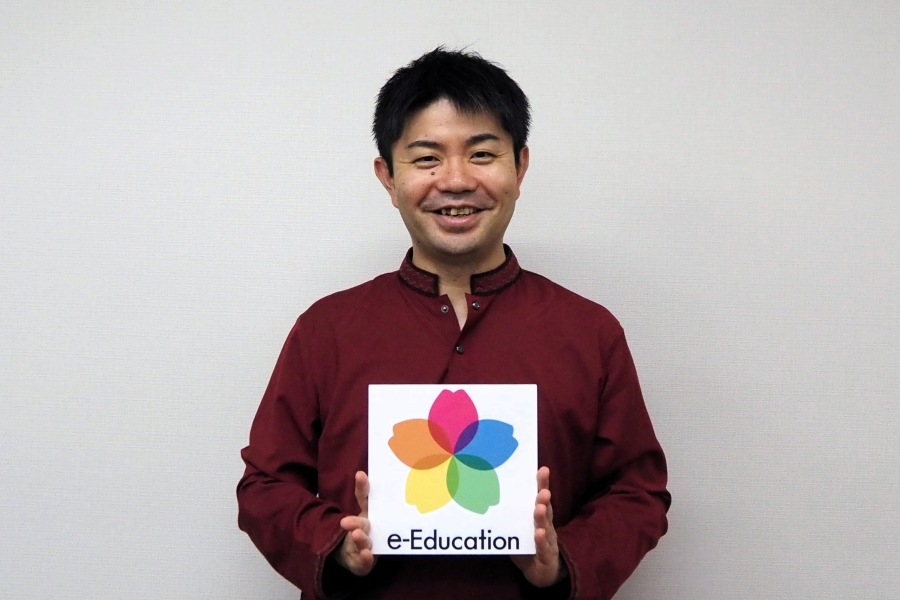
The NPO e-Education provides ICT-based educational services in developing countries, including Bangladesh, to ensure all children have access to education. Additionally, they provide educational programs for children with foreign roots living in Japan.
The NPO e-Education, with the mission of “Best Education to Edge of the World” has delivered education to over 50,000 middle and high school students across 15 countries and regions since its founding in 2010. We spoke with Mr. Kaito Miwa, a founding member of the NPO e-Education, and the organization’s current CEO.
Using Education to Pave the Way for Children's Brighter Future
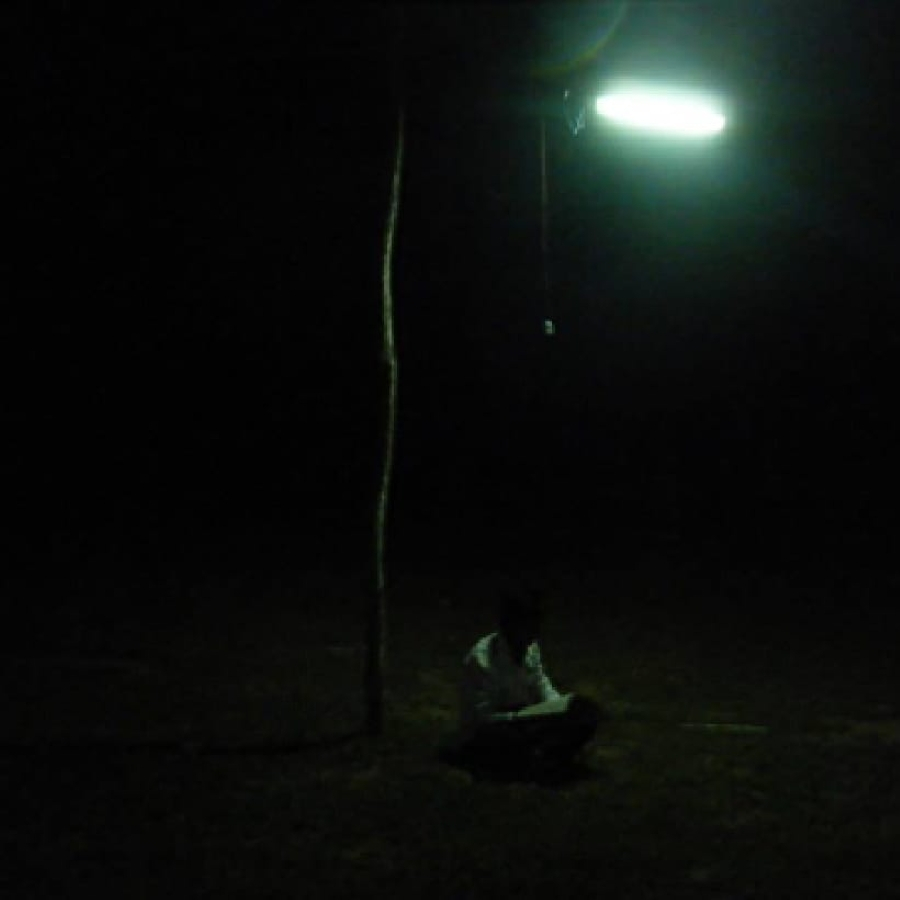
Mr. Miwa decided to start the journey of the NPO e-Education.
Photo Courtesy: NPO e-Education
Mr. Miwa first visited Bangladesh as an intern during his college years, when he aspired to become a social entrepreneur. And he saw children studying by the little available light on the streets in rural areas of Bangladesh late at night.
“I was deeply moved by the energy and potential of children who, for their families, managed work and household chores during the day and then studied diligently late into the night. I felt strongly that I wanted to provide children with a better educational environment and help them build their future.”
Mr. Miwa, and Mr. Atsuyoshi Saisho, who aspired to be a social entrepreneur just like him, jointly thought that the video-class lesson scheme from the prep school they attended during high school could be put to good use. The “e-Education” initiative began in 2010, aiming to deliver high-quality education to children in rural Bangladesh by leveraging this system that enables access to high-quality lessons from anywhere, and by streaming video lessons from top-level instructors.
Mr. Maheen from Bangladesh, who shared Mr. Saisho’s and Mr. Miwa’s vision, was involved in the founding of the NPO e-Education.
Mr. Maheen, who rose from a rural background to gain admission to Bangladesh’s most competitive university, Dhaka University, has contributed to advancing projects in Bangladesh. He now appears in various media outlets as a hero tackling Bangladesh’s educational challenges.
“We consider that only local people can change the local issues. Rather than having Japanese people front the initiative, we place importance on finding leaders within each of these countries and shining the spotlight on them as role models that children can look up to,” says Mr. Miwa. Over 100 international members are now involved with e-Education.
Designing Programs Tailored to the Educational Circumstances of Each Country
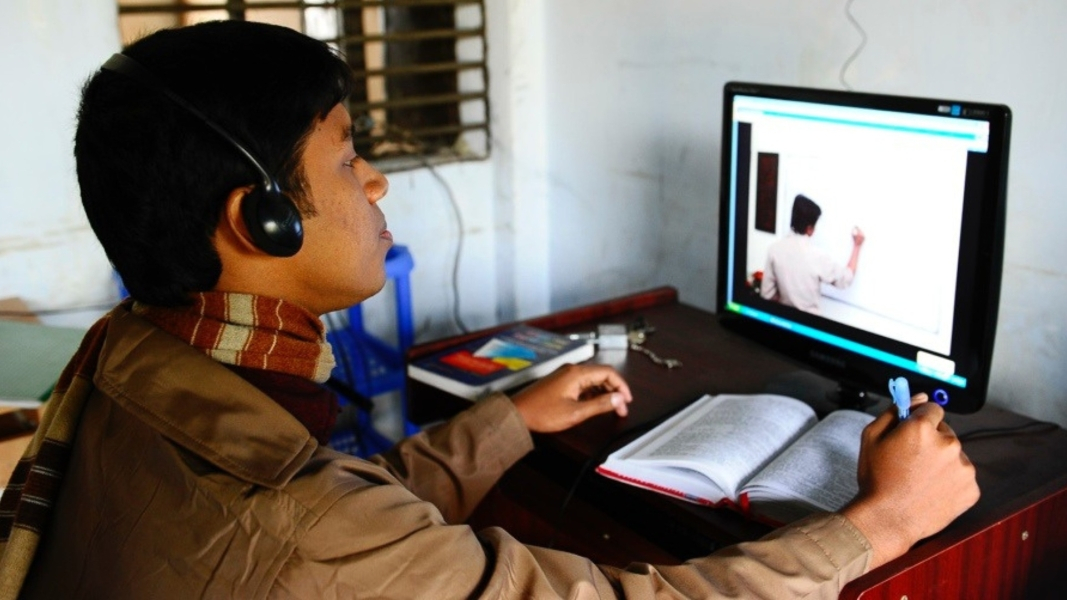 e-Education launched the first video cram school in Bangladesh. This model is spreading rapidly throughout Bangladesh and beyond.
Photo Courtesy: NPO e-Education
In Bangladesh, academic credentials are highly valued, and in the capital city of Dhaka alone, there are over 100 preparatory schools. On the other hand, a severe shortage of teachers, particularly in rural areas, was also a challenge. Therefore, e-Education produced video lectures in collaboration with a talented instructor at a cram school in Dhaka. Delivering lessons taught by instructors who speak the local language is a commitment that e-Education has valued since its beginning. Video education was delivered to a village far from the cities. And the first 18 high school students to participate in the video education program were accepted to prestigious universities, including the University of Dhaka. The village in question was the one where Mr. Maheen, one of the co-founders, was born and raised.
“The villagers lent us a place to study, saying, ‘If Maheen, our local hero, says so.’ And people pooled electricity from each household of the village to help the students prepare for their exams. We all worked together to achieve their acceptance into universities,” says Mr. Miwa. Since the organization's foundation 15 years ago, over 500 young people have been admitted to top-tier universities.
e-Education is currently active in four countries: Bangladesh, the Philippines, Myanmar, and Nepal. And through their activities, they design educational programs tailored to the unique needs of each country.
For example, in the Philippines, the COVID-19 pandemic led to prolonged school closures, forcing children to study at home. This led to concerns about widening disparities in children’s educational opportunities and environments, caused by differences in household internet access, possession of digital devices, financial circumstances, and where they live. Furthermore, in the Philippines, children’s math proficiency levels are significantly lower than international standards, which is considered a social issue. In response, e-Education has partnered with Keirinkan, a Japanese publisher of textbooks, to develop programs supporting math teachers in the Philippines.
“We plan to expand our business and aim to operate in 10 countries by fiscal year 2027,” says Mr. Miwa.
Since the COVID-19 pandemic began, e-Education has made approximately 6,000 online learning resources available for free and has helped many children continue their education.
A Pathway to Entrance Exams Supported by Program Graduates Serving as Role Models
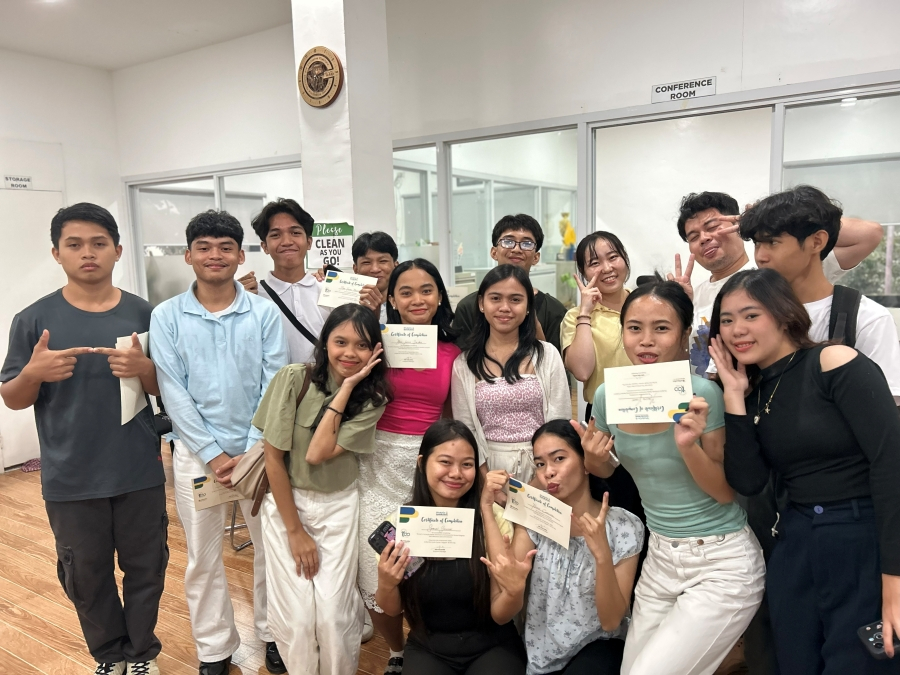 In the Philippines, over 120 students are preparing to take entrance exams for
the Philippines’ most competitive universities.
Photo Courtesy: NPO e-Education
For university entrance exams, a personalized study plan is essential for each individual. It is important to find a study method tailored to each student to develop their strengths or to overcome their weaknesses. For this reason, e-Education offers not only video classes but also “life coaches” who accompany each student throughout their exam preparation journey. Life coaches are primarily former university students who received support from e-Education. They not only help create study plans but also provide mental support.
“Life coaches are the future image of students who are preparing for entrance exams, and they are students’ role models. Seeing life coaches tell students who are having a hard time that they (the life coaches) too overcame the same exams, fills my heart with emotion,” says Mr. Miwa.
The organization supports students who cannot afford tuition fees. In addition, they also provide strong post-exam support, such as contacting each student who did not pass the exam, to interview them about their situation.
“What particularly stuck with me were the words of a student who didn't get into his first-choice university. He told us, ‘e-Education changed my life. I had even given up on taking the entrance exam, but thanks to e-Education, I was able to give it my all. I am proud of my life,’ he said. Through this student’s words, I realized anew that even if you fail to get into your first-choice university, you can still turn that experience into nourishment for life. And that even after the exams are over, life’s journey continues,” says Mr. Miwa. e-Education’s vision - “A Life with Dignity, a Society with Compassion” - also stemmed from this experience.
Providing an Educational Environment Where Children with Foreign Roots Living in Japan Can Learn with Peace of Mind
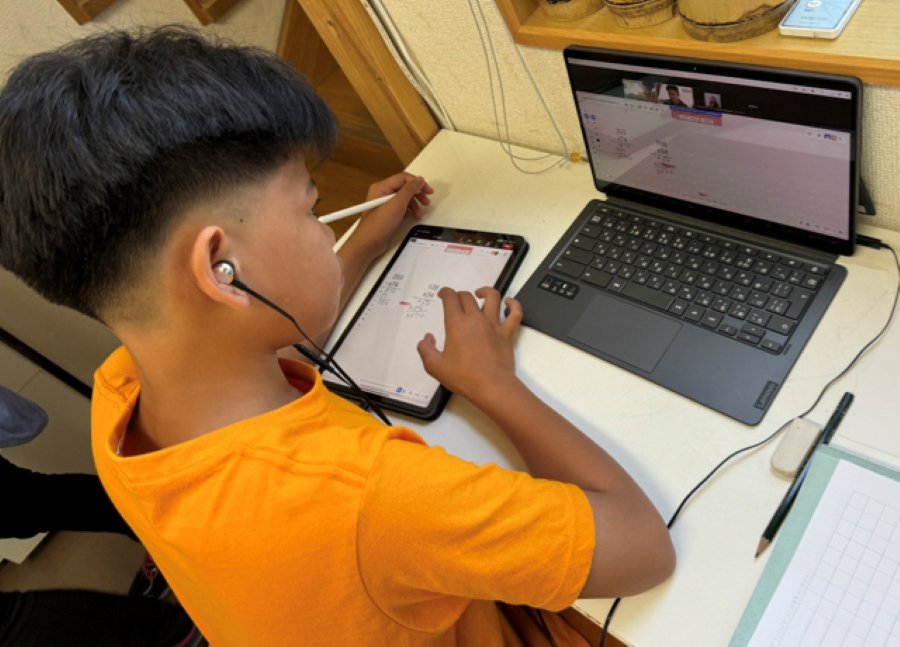 Teaching mathematics in a child’s native or heritage language reduces their perception of the subject as something they struggle with.
Photo Courtesy: NPO e-Education
Starting in 2024, e-Education launched a new initiative to support children with foreign roots living in Japan. A survey conducted independently by e-Education found that, for foreign families who have moved to Japan, their children’s education is more significant than healthcare or their work environment. Conversely, many municipalities still fail to provide enough support for children with foreign roots.
So, e-Education launched online learning support at the “Rainbow Bridge Classroom,” a preschool in Shizuoka Prefecture. e-Education provides Japanese-language education and individualized math support in the participants’ mother tongues.
“Since different countries have different ways of writing numbers and different calculation methods, many children struggle with math in elementary school. We provide support focused on math to address these challenges,” says Mr. Miwa.
Online lessons are conducted one-on-one by graduates of e-Education program, who are currently university students residing in the children’s home countries. This allows children to take math lessons in their mother tongue.
“Children who used to mistake with finger counting or stick counting (a method involving drawing lines), were able to do pen-and-paper arithmetic within a month. Since children can converse in their mother tongue, it seems the classes also serve as a source of comfort for them, which makes me happy,” says Mr. Miwa.
Providing Opportunities to Connect with the World Through Education
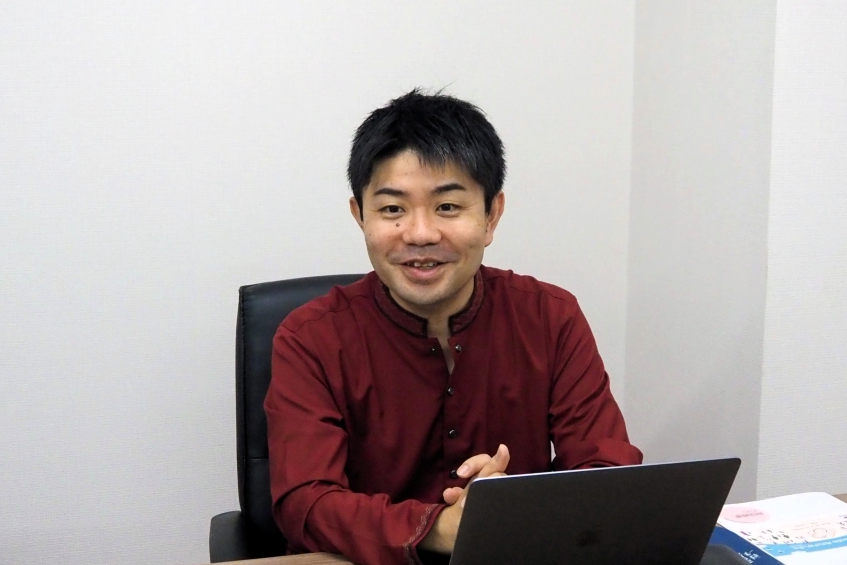 Mr. Miwa passionately shares his thoughts on e-Education.
Currently, e-Education is working to coordinate support for children with foreign roots across Japan, ensuring that even resource-limited municipalities can assist. This system will enable children with foreign roots to receive e-Education’s support online, using class time held outside of their registered classroom.
“With this model, even municipalities that cannot afford to hire support staff due to budget limitations can provide learning support at low cost as long as they have electronic devices. Support should also reach areas where foreign residents are scarce and lack sufficient assistance,” says Mr. Miwa. Inquiries from municipalities are gradually increasing, and e-Education learning support network is expanding throughout Japan.
Mr. Miwa has set the key phrase “Re-international Cooperation” as his future goal.
“Our students who once received support are now making significant contributions to solving Japan’s educational challenges. What strikes me most from my ongoing work in international cooperation is the tremendous power of the people in countries called developing nations. In Japan, many young people say they have nothing they want to do. I think that when kids like that come into contact with the power of people in developing countries, it could be an opportunity that changes their lives, just as it did for me. It would be wonderful if we could create opportunities to connect with the world through education,” says Mr. Miwa.
e-Education logo depicts cherry blossoms - a symbol of university entrance exam success in Japan - represented by five petals in colors signifying the five continents. “Best Education to Edge of the World.” e-Education’s challenge to educational tasks continues.