


Community "Nihongo Kyoshitsu" Activities Report, vol.23
The regional Japanese language education coordinators of the Tokyo Metropolitan Foundation “TSUNAGARI” are visiting Japanese classes in Tokyo and introducing them in the Community “Nihongo Kyoshitsu” Activities Report.
In our twenty-third report, we are introducing the Kiyose International Club (KIC) Nihongo Class (Kiyose City)
About Kiyose City
Kiyose City is located in the northern part of Tokyo, bordering Niiza City, Saitama Prefecture to the east; Tokorozawa City, Saitama Prefecture to the north; Higashimurayama City to the west; and Higashikurume City to the south. The Seibu Ikebukuro Line runs through the city, offering good access to central Tokyo, while Kiyose is also known as a calm residential city with abundant greenery and farmland. It is also famous as a “city of medicine”: since the early Showa era, tuberculosis sanatoriums and research institutes have been established here, and, carrying on that tradition, a number of medical institutions and research facilities are still located in the city today.
Population (as of April 1, 2026): 75,971
Foreign resident population: 2,029
Kiyose International Club (KIC) Nihongo Class
The founding of this class is closely connected to Kiyose’s identity as a “city of medicine.” After the Research Institute of Tuberculosis was established in the early Showa era, medical professionals from around the world came to Kiyose for training. In order to create opportunities for these visitors to interact with local residents, the city called for an exchange gathering, which was held in 1991. This led to further calls for interaction with foreign residents already living in Kiyose, and in April 1992, “Kiyose International Club (KIC),” the parent organization of the KIC Nihongo Class, was established. The Nihongo class itself began the following year, in 1993, and continues to this day. Besides the Nihongo class, KIC carries out a wide range of activities, including an English conversation group (“The Shaberankai”), the “KIC Chorus,” and multicultural and international exchange activities.
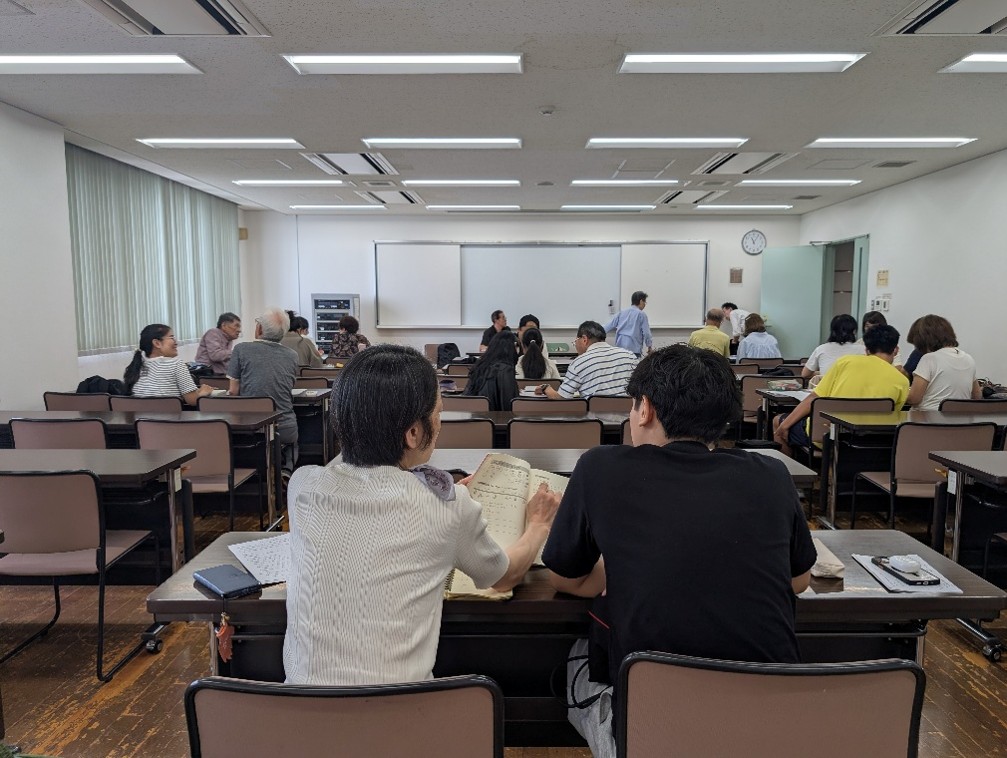
A scene from the classroom
Activities of the Kiyose International Club (KIC) Nihongo Class
KIC has around 65 members, of whom about 50 are Japanese-language volunteers.
There are also around 50 learners. Perhaps because there is a Catholic church nearby, there are relatively many learners from the Philippines, as well as many from African countries such as the Congo, Cameroon, Nigeria, and Tanzania.
Mr. Kubodera, the representative of the Nihongo class, has lived in Kiyose for 50 years. He began volunteering with the KIC Nihongo Class two years ago. Having always loved Japanese culture, including Zen, his involvement began when he signed up for the training course for Japanese-language volunteers.
He was deeply moved by something one of the course instructors said, that Japanese culture lies behind the Japanese language, and he has continued his volunteer activities ever since.
Mr. Ishii, the club’s chairperson, is also a long-time Japanese-language volunteer.
He first had the chance to take part in a Nihongo class while working away from his family on a job posting. Although he was not particularly active afterward, the experience came back to him after retirement, and he signed up for the Japanese-language volunteer training course. He has been active with KIC ever since 2011.
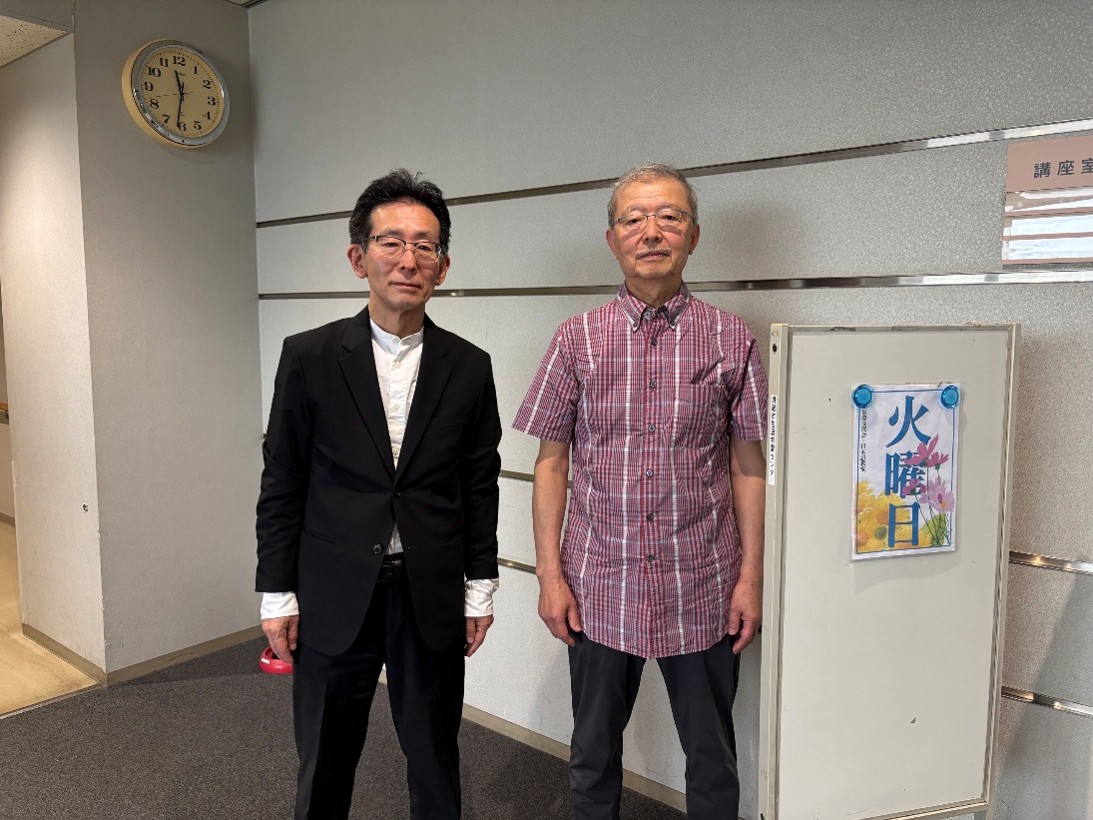
Representative Kubodera (left) and Chairperson Ishii (right)
The Value of Learning Together with the Learners
Both Mr. Ishii and Mr. Kubodera say that what they enjoy most is learning alongside the learners. Mr. Ishii once learned how to make dumplings (gyoza) from one of the learners and later tried making them himself. Mr. Kubodera says that through conversations with a learner from India, he came to learn about life and values within Indian households, which renewed his appreciation for the importance of family. Since the number of learners and supporters is roughly equal, lessons are mostly conducted one-on-one, creating an atmosphere in which people can really take their time to talk with one another.
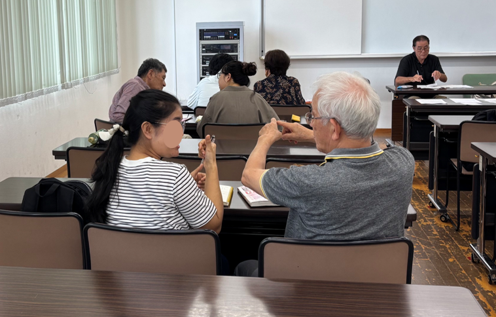
Learning happily with the help of gestures
Independent Operation While Cooperating with the City
In running the class, there was a clear awareness of maintaining independence while also cooperating with Kiyose City.
The classroom is located right in front of Kiyose Station, making it very easy to access. Thanks to its cooperation with the city, the group is able to secure the venue on a priority basis.
The operating committee members, known as “sewanin,” rotate on a set schedule, with a variety of people taking turns running the class together. Activities including training sessions for volunteers are also organized independently by the club itself, with outside instructors invited to lead them.
Thoughts on our visit…
This was a cheerful, calm, and warm classroom.
With learning conducted almost entirely one-on-one, it was striking to see how happily the learners and supporters interacted with each other, each learning from the other.
In terms of operations, I was drawn to how the group values its cooperation with the city while still maintaining its independence and carrying out such a wide variety of activities.
by YO