


Community "Nihongo Kyoshitsu" Activities Report, vol.21
The regional Japanese language education coordinators of the Tokyo Metropolitan Foundation “TSUNAGARI” are visiting Japanese classes in Tokyo and introducing them in the Community “Nihongo Kyoshitsu” Activities Report.
In our twenty-first report, we are introducing the Inagi Japanese Volunteer Association (Inagi City)
About Inagi City
Inagi City is located in the Minami-Tama area of Tokyo, at the eastern edge of the metropolis, bordering Kawasaki City in Kanagawa Prefecture. It is a quiet residential city nestled between the Tama River and the Tama Hills.
Along the Misawa River, which flows through the heart of the city, approximately 320 cherry trees have been planted, offering a vivid sense of the changing seasons. Pears are the city’s most prized local specialty. The pears grown within the city are said to be juicy, sweet, and delightfully crisp in texture. During the season, pears are sold directly at orchards throughout the city, attracting buyers from well beyond the city limits.
Population (as of October 1st, 2025): 94,536
Foreign population: 2,250
Inagi Japanese Volunteer Association
The Japanese language classes run by the Inagi Japanese Volunteer Association take place at the Central Public Hall and the Third Public Hall in Inagi City, with sessions held on Thursdays, Fridays, and Saturdays. A total of 62 learners attend, representing 16 different nationalities.
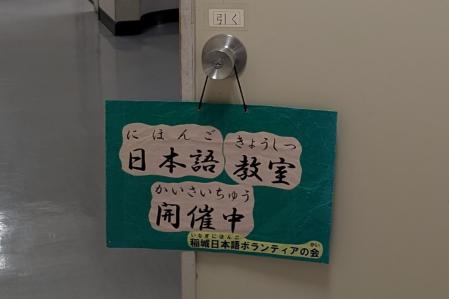
For this report, we visited the Saturday class held at the Central Public Hall, located near Inagi Station.
The Saturday class has 25 learners supported by 18 volunteers, with one volunteer typically working with one or two learners at a time.
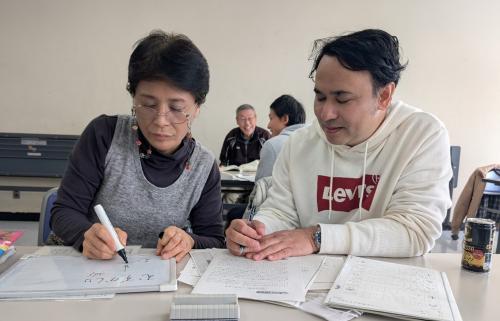
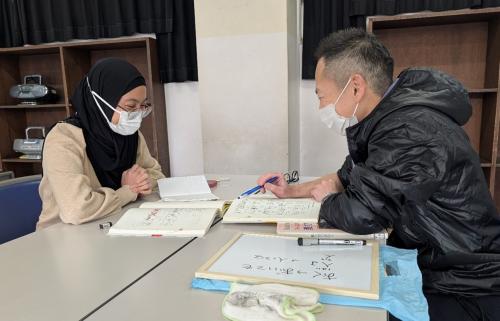
The Public Hall and Japanese Language Classes
The Japanese language classes run by the Inagi Japanese Volunteer Association have been in operation since fiscal year 1994, with the support of the Inagi City Lifelong Learning Division (Public Hall).
The Association itself handles the day-to-day management of the classes as well as the planning of events and activities. The Inagi City Lifelong Learning Division, meanwhile, takes responsibility for organizing volunteer training and follow-up courses, securing venues, and providing Japanese language learning materials.
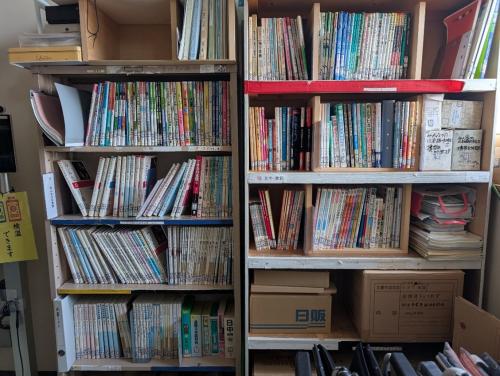
One room at the Central Public Hall serves as a storage space for Japanese language learning materials.
The Japanese language classes run by the Inagi Japanese Volunteer Association have been in operation since fiscal year 1994, with the support of the Inagi City Lifelong Learning Division (Public Hall).
The Association itself handles the day-to-day management of the classes as well as the planning of events and activities. The Inagi City Lifelong Learning Division, meanwhile, takes responsibility for organizing volunteer training and follow-up courses, securing venues, and providing Japanese language learning materials.
Each year, the public hall also hosts a speech contest as a platform for learners to showcase their Japanese language skills. Open to learners from all class days, the event regularly draws large numbers of learners and their families. This year, a staff member from the Inagi Fire Station was invited to speak about disaster preparedness in plain Japanese (yasashii nihongo), making the occasion an opportunity to share practical information useful in daily life.
All event planning of this kind is carried out entirely by the Association’s volunteer supporters. Volunteers take on not only event planning roles, but also responsibilities such as training coordination and scheduling. Every volunteer has some kind of designated role, and the class is run through the collective effort of all members.
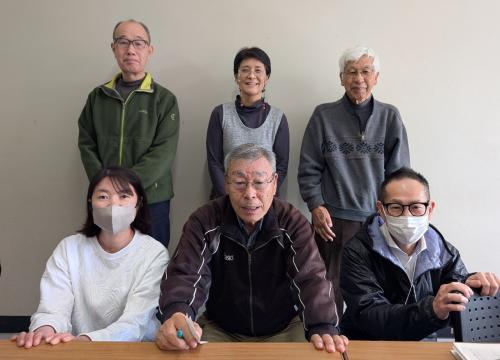
The Saturday volunteers
Thoughts on our visit…
The longest-serving volunteer at the Saturday class we visited has been active since 1997.
We felt that the reasons these Japanese language classes has endured for so many years are threefold: the public hall as an accessible, welcoming “space” for local residents to gather; the “support of the city”; and above all, the “power of local residents” who continue their volunteer work with genuine enjoyment.
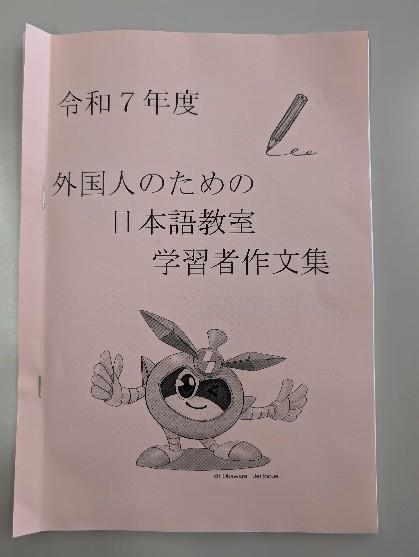
The Inagi Japanese Volunteer Association also compiles a collection of essays written by learners. Many learners wrote their essays by hand, and we were struck by how meaningful it is to have the fruits of the collaboration between learners and volunteers preserved in a tangible form.
by AS