


Community "Nihongo Kyoshitsu" Activities Report, vol.19
The regional Japanese language education coordinators of the Tokyo Metropolitan Foundation “TSUNAGARI” are visiting Japanese classes in Tokyo and introducing them in the Community “Nihongo Kyoshitsu” Activities Report.
In our nineteenth report, we are introducing " Kojimamachi 2-chome Danchi Japanese Language Classroom" in Edogawa city!
About Edogawa city
Edogawa City is located in the eastern part of Tokyo’s 23 wards, bordering Ichikawa City and Urayasu City in Chiba Prefecture to the east. With an area of approximately 49.90 km², it is relatively large among the 23 wards, consisting mainly of residential neighborhoods, with nearby parks and waterfront spaces along riverbanks, creating a neighborhood where daily life thrives. The area is characterized by both excellent access to central Tokyo and a calm residential environment.
Additionally, Edogawa City continues to see growth in its foreign resident population, making it the municipality with the largest number of foreign residents in Tokyo (as of December 2025). As a region where people with roots in diverse countries and cultures live, a Multicultural Coexistence Centre was established in fiscal year 2024, advancing consultation services and Japanese language education initiatives, strengthening the foundation for multicultural coexistence within the community.
Population (latest published figures for 2025): 697,668
Foreign population: 52,685
Kojimamachi 2-chome Danchi Japanese Language Classroom
The Kojimamachi 2-chome Danchi Japanese Language Classroom is hosted by the Kojimamachi 2-chome Danchi Residents’ Association and held at the community center within the housing complex.
While the classroom is operated by the residents’ association, both Japanese and foreign residents living in the complex are involved in its operation. The participation requirement is membership in the residents’ association, and no fees are charged. Classes are held once every two weeks.
Learners are foreign residents living in the complex, with many participating as families or through invitations from acquaintances, expanding participation through connections formed in everyday life. Currently, activities are conducted in a calm atmosphere at a manageable scale where everyone knows each other.
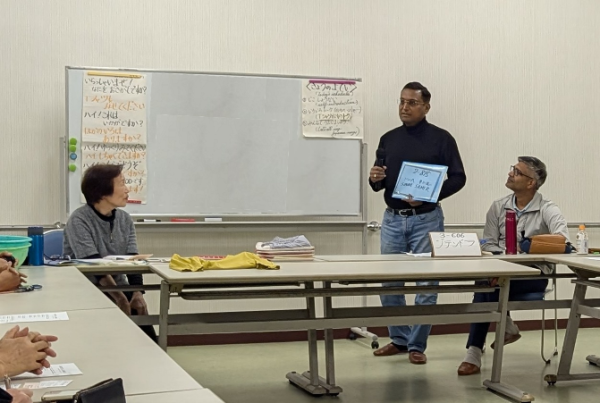
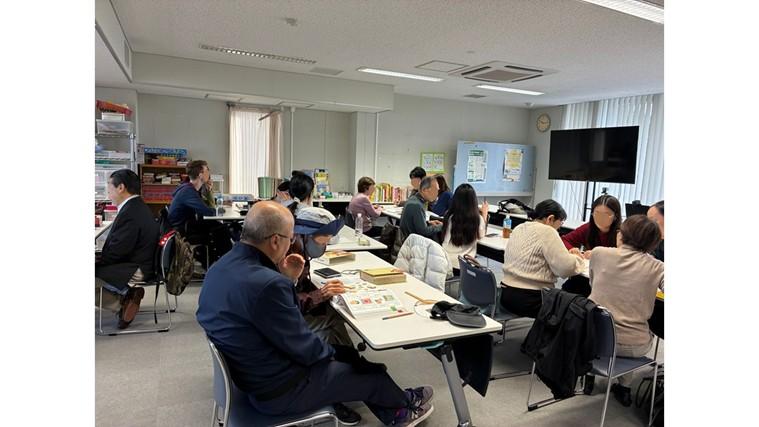
Classroom Management that Values Mutual Learning Among Residents
On this particular day, the classroom included activities such as:
① Self-introductions, ② Free conversation time (shopping interactions), and ③ “Let’s sing together.”
During self-introductions, topics related to housing and daily life were naturally exchanged, providing opportunities for residents living in the complex to get to know each other. We observed interactions rooted in everyday life, characteristic of a classroom hosted by a residents’ association.
For the shopping interaction activity, conversation practice simulating shopping scenarios was conducted using pre-prepared materials. Learning content is determined based on participants’ requests, and kanji study is also incorporated to support continued learning.
Learners shared that opportunities to speak with Japanese people in daily life are limited, so being able to speak Japanese at this classroom brings them joy.
Beyond a simple teacher-learner relationship, time naturally emerges for residents living in the same area to meet face-to-face and exchange words.
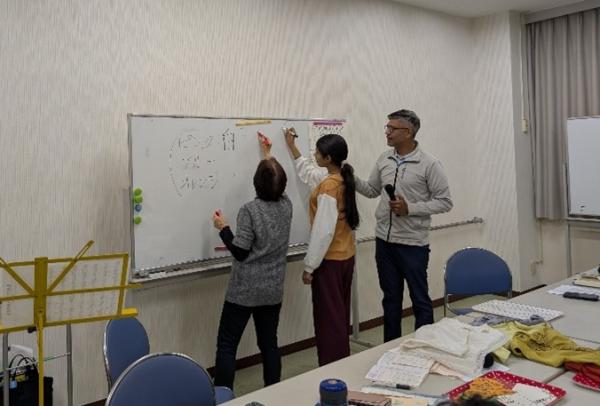
Thoughts on our visit…
With the residents’ association hosting the Japanese language classroom within the housing complex as a living space, we felt that the classroom serves not only as a place for learning but also as a space where residents build relationships through language.
The fact that participants do not need to leave the complex makes the physical barrier to participation low, which is one of this classroom’s distinctive features.
This initiative left a strong impression on us as an effort that fosters connections between people in a form that can be sustained naturally within the community.
by MN